Cone flat pattern: the formula and a worked example
A right cone unrolls to a part of a flat ring, so its pattern needs no triangulation: two arcs from one centre, cut by two straight lines. A truncated cone, or frustum, needs three numbers: the two radii of the arcs and the angle between the straight lines.
The formula
R and r are the radii of the large and small ends, mid-thickness, and h is the height between them.
| What | Formula | Example: R 300, r 150, h 200 |
|---|---|---|
| Slant height | L = √(h² + (R − r)²) | √(200² + 150²) = 250 mm |
| Large arc radius | A = L × R ÷ (R − r) | 250 × 300 ÷ 150 = 500 mm |
| Small arc radius | B = L × r ÷ (R − r) | 250 × 150 ÷ 150 = 250 mm |
| Sector angle | θ = 360° × (R − r) ÷ L | 360 × 150 ÷ 250 = 216° |
| Check: large arc length | 2π × R | 1,885 mm |
| Check: small arc length | 2π × r | 942 mm |
Laying it out
- Set the trammels to 500 mm and draw the large arc. Without moving the centre, draw the small arc at 250 mm.
- Draw one straight line from the centre through both arcs.
- Measure 216° from it and draw the second line. If the sector is too big to measure well, step the chord: 2 × A × sin(θ ÷ 2) = 951 mm on the large arc.
- Add the seam allowance along one straight edge.
When this does not apply
The formula is for a right cone, with both ends parallel and on one centreline. An eccentric or oblique cone has no single arc centre, and is developed by triangulation, as in the square to round guide. The cone calculator handles both.
A long flat cone can have a radius too large to swing, because R − r is small compared with L. Then the arcs are plotted by ordinates, and a multi-section cone may suit better.
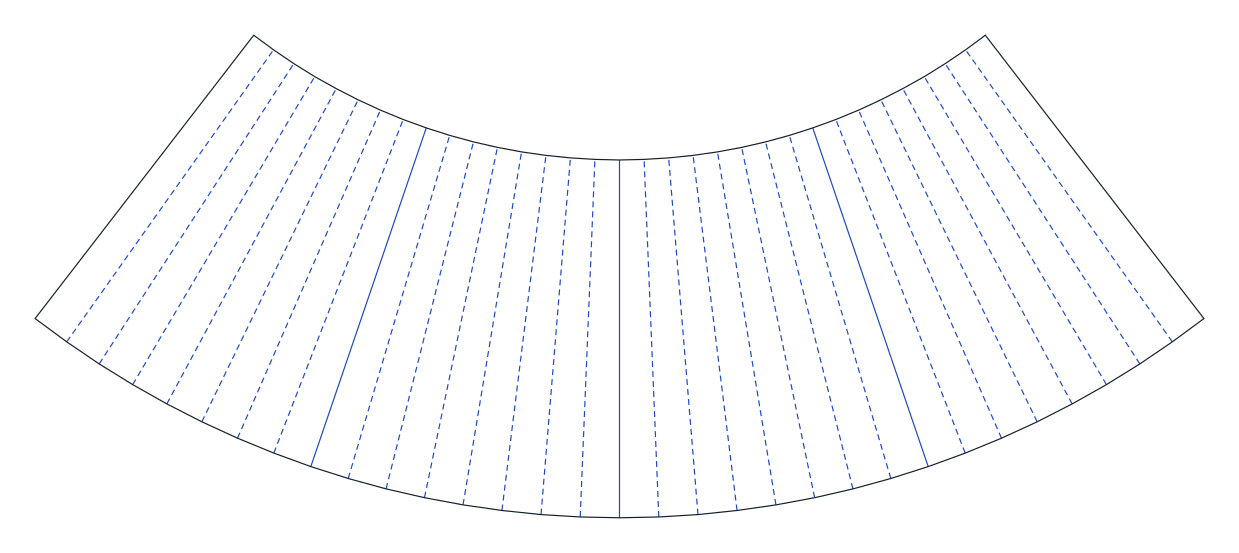
Sample files of this pattern at its default sizes: PDF · DXF
Open the calculatorCheck every pattern against your own standards before cutting.