How to lay out a lobster back elbow
A lobster back, or segmented, elbow makes a bend from short lengths of straight pipe called gores. Each gore is cut on two slanting planes, so its flat pattern is a band with a wave along each edge. Every gore in a bend comes from the same set of ordinates.
The example
A 90° bend, 200 mm mid-thickness diameter, 300 mm bend radius, with 4 joints: 3 full gores and 2 half gores at the ends.
Step 1: the angle of each cut
The angle at each joint is the bend angle divided by the joints: 90 ÷ 4 = 22.5°. Each side of a joint takes half of it, so the cut is θ ÷ 2 = 11.25°, and tan 11.25° = 0.1989.
Step 2: the ordinates
Divide the circumference into 12 parts. The band is π × 200 = 628.3 mm long, so the stations are 52.4 mm apart. φ is the position round the pipe: 0° at the back of the bend and 180° at the throat. With r the pipe radius and R the bend radius, the height from the centreline of the gore to its edge at each station is:
y = (R + r × cos φ) × tan(θ ÷ 2)
| Position φ | Half gore y (mm) | Full gore 2y (mm) |
|---|---|---|
| 0° | 79.6 | 159.1 |
| 30° | 76.9 | 153.8 |
| 60° | 69.6 | 139.2 |
| 90° | 59.7 | 119.3 |
| 120° | 49.7 | 99.5 |
| 150° | 42.4 | 84.9 |
| 180° | 39.8 | 79.6 |
Step 3: lay out the gore
- Draw a centreline 628.3 mm long and mark the 13 stations, 52.4 mm apart, with the seam at the throat or the back.
- At each station, mark y above and below the centreline. Stations 30° to 150° repeat on the other side of the pipe.
- Join the marks with a smooth curve on each edge. Each end gore is one side of this, with a straight end.
- Nest the gores on one strip, so that the wave of one is the wave of the next and a single cut makes both edges.
Fewer or more gores
More gores make a smoother, lower-loss bend and more welding. Change the number of joints and the whole table changes with it; the elbow calculator redraws it at once, and can split each gore in two halves for work too big for one sheet.
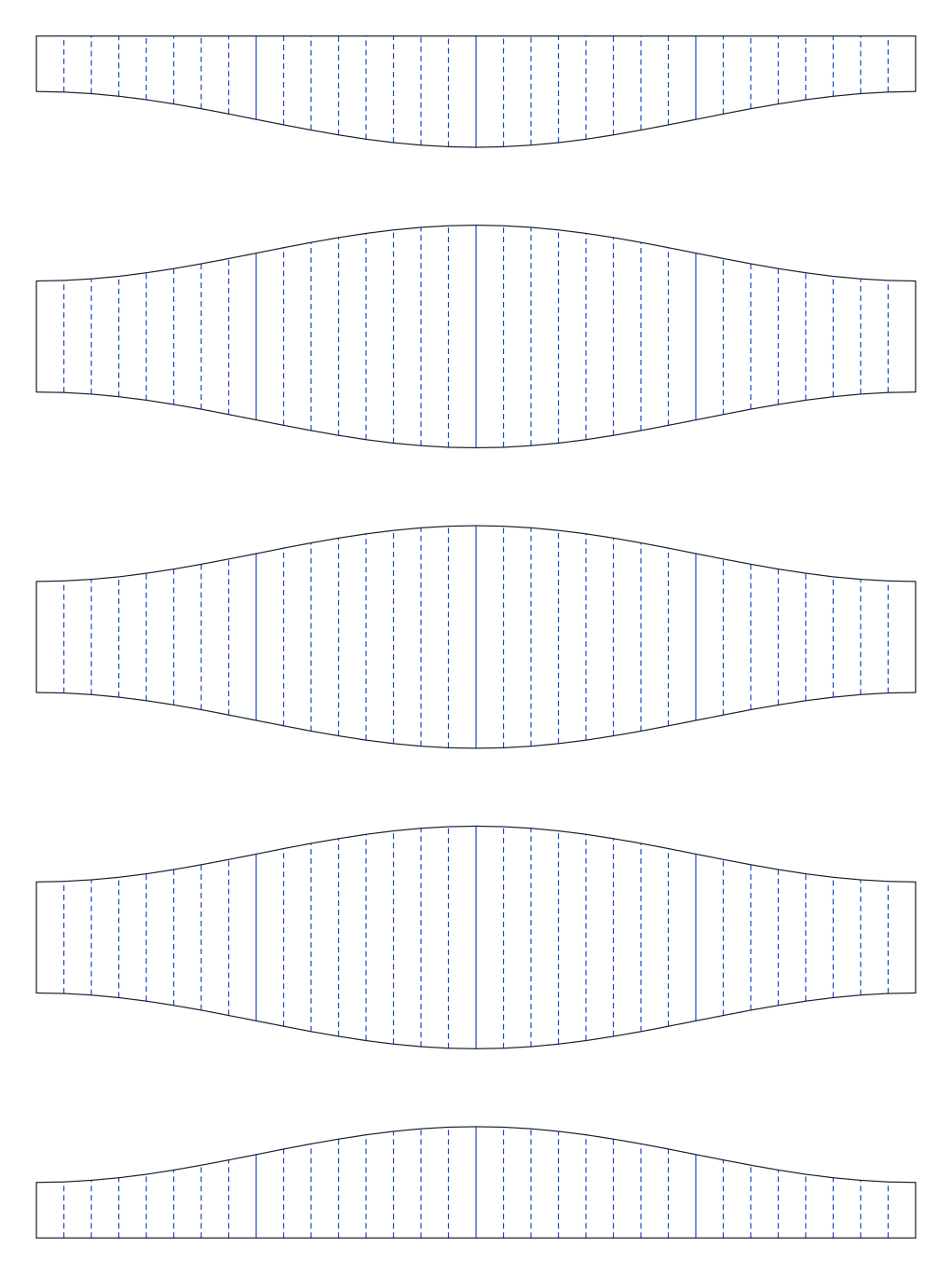
Sample files of this pattern at its default sizes: PDF · DXF
Open the calculatorCheck every pattern against your own standards before cutting.